
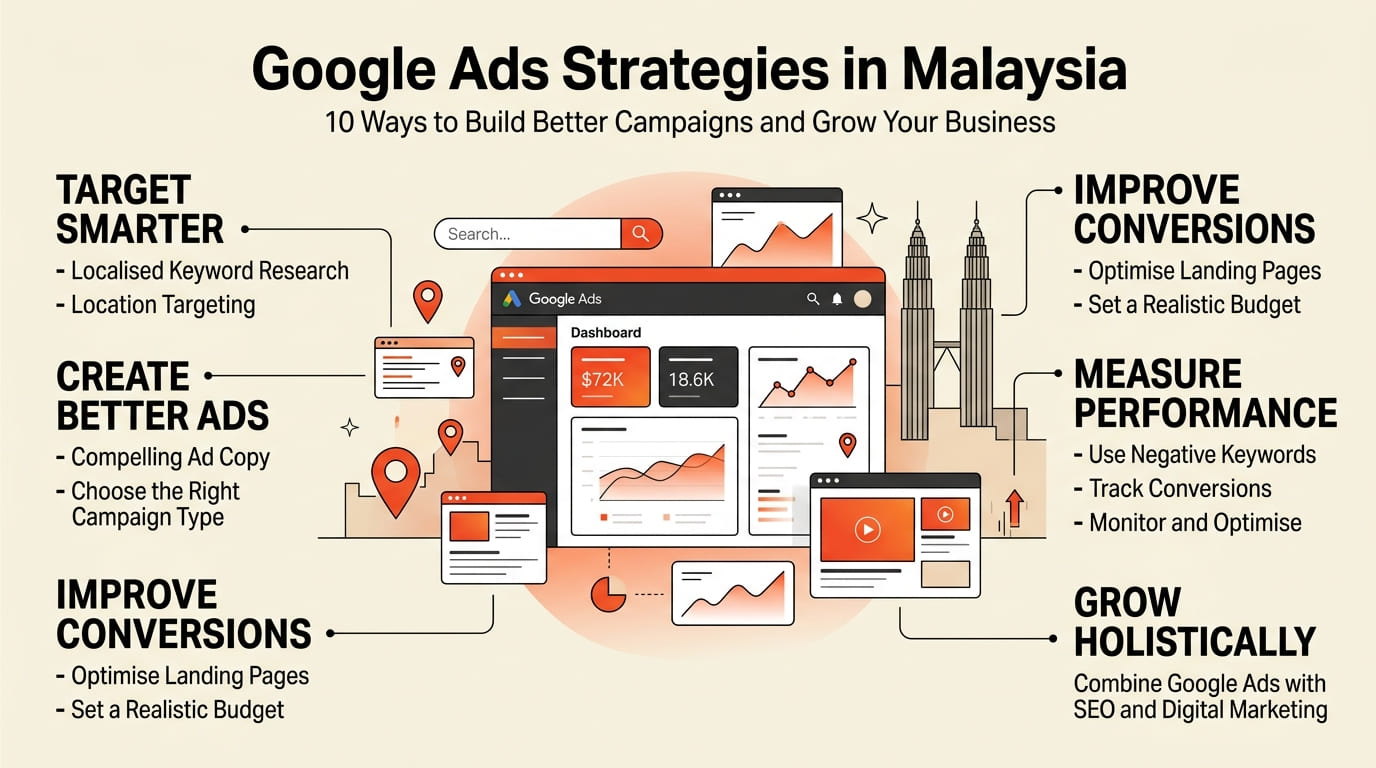
Google Ads Strategies for Success in Malaysia
Google Ads Strategies in Malaysia: A Practical Guide for Business Growth
Google Ads is a digital advertising platform that helps businesses reach potential customers when they search for products or services online. For businesses in Malaysia, effective Google Ads strategies can improve online visibility, attract relevant website traffic and generate opportunities for enquiries and sales.
However, running successful Google Ads campaigns involves more than choosing keywords and setting a budget. Businesses need to understand their target audience, select suitable campaign objectives, create relevant advertisements and monitor performance regularly.
In this guide, we explore practical Google Ads strategies in Malaysia that businesses can use to improve campaign performance and make better advertising decisions.
1. Conduct Localised Keyword Research
Keyword research is an important part of planning Google Ads campaigns. Businesses should identify the search terms potential customers use when looking for their products or services.
For example, a Malaysian web design company may target relevant searches such as:
- Web design company Malaysia
- Website design services Malaysia
- Website development company Kuala Lumpur
- Affordable website design Malaysia
- Professional web design services
The most suitable keywords depend on the business’s services, target audience and campaign objectives.
Use keyword research tools to evaluate search demand, competition and estimated advertising costs. Group closely related keywords into relevant ad groups so that the advertisements and landing pages match the user’s search intent.
Avoid selecting keywords based only on search volume. Relevant searches that are more likely to lead to enquiries may be more valuable than broad searches that attract unqualified visitors.
2. Use Location Targeting Strategically
Location targeting allows businesses to focus their advertising on geographical areas relevant to their customers.
A company serving customers throughout Malaysia may target the country broadly, while a business that primarily serves a particular city may choose more specific locations.
For example, a web design company targeting local businesses could test campaigns focused on Kuala Lumpur, Selangor or other serviceable areas.
When setting up location targeting, consider:
- The areas where your business can provide services.
- The locations of your ideal customers.
- Differences in demand between regions.
- Whether the campaign should target Malaysia nationally or selected locations.
Review location performance regularly and adjust targeting based on relevant enquiries and conversion data.
3. Write Relevant and Compelling Ad Copy
Your advertisement should communicate what your business offers and why potential customers should consider your services.
Effective ad copy should match the searcher’s intent, highlight relevant benefits and provide a clear next step.
For example, an advertisement promoting website design services could emphasise professional website development, responsive design or tailored business solutions, provided these accurately describe the services offered.
Consider these best practices:
- Include relevant keywords naturally in headlines and descriptions.
- Communicate the main benefit of your service.
- Use specific and accurate messaging.
- Include a clear call to action, such as “Get a Quote” or “Contact Us”.
- Ensure that your claims match the content on the landing page.
Test different headlines and descriptions to understand which messages generate more relevant engagement and enquiries.
4. Choose the Right Google Ads Campaign Type
Google Ads offers different campaign types for different marketing objectives. The appropriate option depends on the business, target audience, available creative assets and desired outcomes.
Search Campaigns
Search campaigns can display advertisements when users search for relevant terms on Google. They may be suitable for businesses targeting people who are actively looking for particular products or services.
Display Campaigns
Display campaigns can help businesses reach audiences across eligible websites and apps. They may be useful for building awareness or supporting remarketing strategies.
Video Campaigns
Video campaigns allow businesses to promote their products or services through video advertising placements, including eligible YouTube inventory.
Performance Max Campaigns
Performance Max uses Google’s automation to help advertisers reach audiences across eligible Google advertising channels. Its suitability depends on campaign objectives, conversion tracking and the assets available.
Choose campaign types based on your objectives rather than using every available option. Ensure that conversion tracking is configured appropriately before evaluating campaign performance.
5. Optimise Landing Pages for Conversions
A well-managed advertising campaign can still perform poorly if the landing page does not meet visitors’ expectations.
The landing page should provide a clear continuation of the advertisement. If an ad promotes web design services, visitors should arrive at a relevant page explaining those services rather than a general page with unrelated information.
To improve the landing page experience:
- Use a clear and relevant page heading.
- Explain your services and benefits.
- Make contact forms easy to complete.
- Provide visible contact details or a suitable enquiry option.
- Ensure the page works well on mobile devices.
- Optimise page loading performance.
- Use clear calls to action.
For businesses investing in website improvements, professional web design and development services can help create a more user-friendly experience for potential customers.
6. Set a Realistic Budget and Bidding Strategy
Google Ads budgets should reflect the business’s objectives, advertising costs and ability to convert visitors into customers.
Before launching a campaign, decide how much you can reasonably invest and what outcome you want to measure. Review keyword costs, expected traffic and the value of a qualified enquiry or sale.
When choosing a bidding strategy, consider your campaign objective and the reliability of your conversion data. Automated bidding strategies may be useful when sufficient relevant data is available, while other approaches may be more suitable in different circumstances.
Monitor spending regularly and avoid increasing budgets simply because a campaign receives many clicks. Evaluate whether the traffic is relevant and whether it contributes to meaningful business outcomes.
7. Use Negative Keywords to Reduce Irrelevant Traffic
Negative keywords help prevent advertisements from showing for certain searches that are not relevant to your business.
For example, a company offering paid website design services may want to review searches containing terms such as “free”, “tutorial” or “course” if those searches do not match its target customers.
The appropriate negative keywords depend on the services offered and the actual search terms triggering advertisements.
Review your search terms report regularly to identify irrelevant queries. Add negative keywords carefully to reduce wasted spend without excluding searches that could lead to valuable customers.
8. Track Conversions and Measure Campaign Performance
Clicks and impressions can help explain advertising reach and engagement, but they do not necessarily indicate business success.
Businesses should configure conversion tracking to measure actions that matter, such as:
- Contact form submissions.
- Qualified lead enquiries.
- Telephone clicks.
- WhatsApp clicks.
- Online purchases, where applicable.
A click on a telephone number or WhatsApp link is not automatically a confirmed enquiry or sale. Where possible, assess the quality of leads and connect advertising data with reliable business outcomes.
Useful metrics may include:
Click-through rate (CTR): The proportion of ad impressions that result in clicks.
Cost per click (CPC): The average amount paid for each advertising click.
Conversion rate: The proportion of relevant interactions that result in a tracked conversion.
Cost per conversion: Advertising spend divided by the number of recorded conversions, provided the conversion tracking is configured correctly.
Return on ad spend (ROAS): The revenue attributed to advertising divided by advertising spend, when reliable revenue tracking is available.
Review these metrics together rather than relying on one number to judge campaign success.
9. Test and Optimise Campaigns Regularly
Google Ads performance can change as customer demand, competition, search behaviour and campaign settings change.
Regular optimisation helps businesses identify areas that need improvement.
Consider reviewing:
- Search terms and keyword performance.
- Ad headlines and descriptions.
- Location and device performance.
- Landing page engagement.
- Budget allocation and bidding strategy.
- Conversion tracking accuracy.
- The quality of leads generated.
Make changes based on meaningful data and evaluate their effects over an appropriate period. Avoid making frequent, unnecessary changes that make it difficult to understand what is influencing results.
10. Combine Google Ads with SEO and Digital Marketing
Google Ads can provide paid visibility for relevant searches, while search engine optimisation (SEO) focuses on improving organic search visibility.
These approaches serve different purposes, but they can support a broader digital marketing strategy.
Google Ads can help businesses test advertising messages and attract paid traffic. SEO can help improve the website’s visibility in organic search results over time. Social media marketing can support audience engagement and help businesses distribute relevant content.
The right combination depends on your budget, industry, target audience and business goals.
Businesses can explore IO Web Studio’s SEO services and digital marketing services to learn more about related ways to strengthen their online presence.
Frequently Asked Questions About Google Ads in Malaysia
How much does Google Ads cost in Malaysia?
Google Ads costs depend on factors such as keyword competition, targeting, industry, bidding strategy and campaign objectives. Advertisers control their budgets, but actual costs and results vary. Review your campaign performance regularly to understand whether your advertising investment supports your business goals.
How long does it take to see results from Google Ads?
Campaigns can begin receiving impressions and clicks after they become eligible to serve, but meaningful results depend on factors such as campaign setup, competition, budget, landing page quality and conversion tracking. Allow sufficient time and relevant data to evaluate performance.
Is Google Ads suitable for small businesses?
Google Ads can be suitable for small businesses when campaigns are planned around realistic objectives and budgets. Start with relevant keywords, a clearly defined audience and appropriate conversion tracking, then refine the campaign based on performance.
What is the difference between Google Ads and SEO?
Google Ads provides paid advertising placements, while SEO focuses on improving visibility in organic search results. Google Ads can generate paid traffic while a campaign is active, whereas SEO is an ongoing process that can support organic visibility over time. Both require appropriate measurement and a strategy aligned with business objectives.
How can I improve my Google Ads campaign performance?
Start by reviewing search terms, keyword relevance, ad messaging, landing page experience and conversion tracking. Use reliable performance data to identify areas for improvement and test changes carefully. Better performance depends on the campaign’s objectives and the quality of the traffic and conversions it generates.
Can Google Ads generate leads for my business?
Google Ads can help businesses reach potential customers searching for relevant services. Lead generation depends on factors such as targeting, advertising messages, landing page experience, budget and follow-up processes. Configure conversion tracking and assess lead quality to understand campaign effectiveness.
Conclusion
Effective Google Ads strategies in Malaysia begin with understanding your target audience, selecting relevant keywords and creating advertisements that match customer needs. Location targeting, compelling ad copy, suitable campaign types and well-designed landing pages can all contribute to a stronger campaign.
Businesses should also monitor conversion tracking, review performance metrics and optimise campaigns based on reliable data. Rather than focusing solely on clicks, prioritise relevant traffic and measurable business outcomes.
IO Web Studio provides digital solutions that can help businesses strengthen their online presence through website design, SEO and digital marketing. Explore our Google Ads and Google marketing services or contact IO Web Studioto discuss your business requirements.