
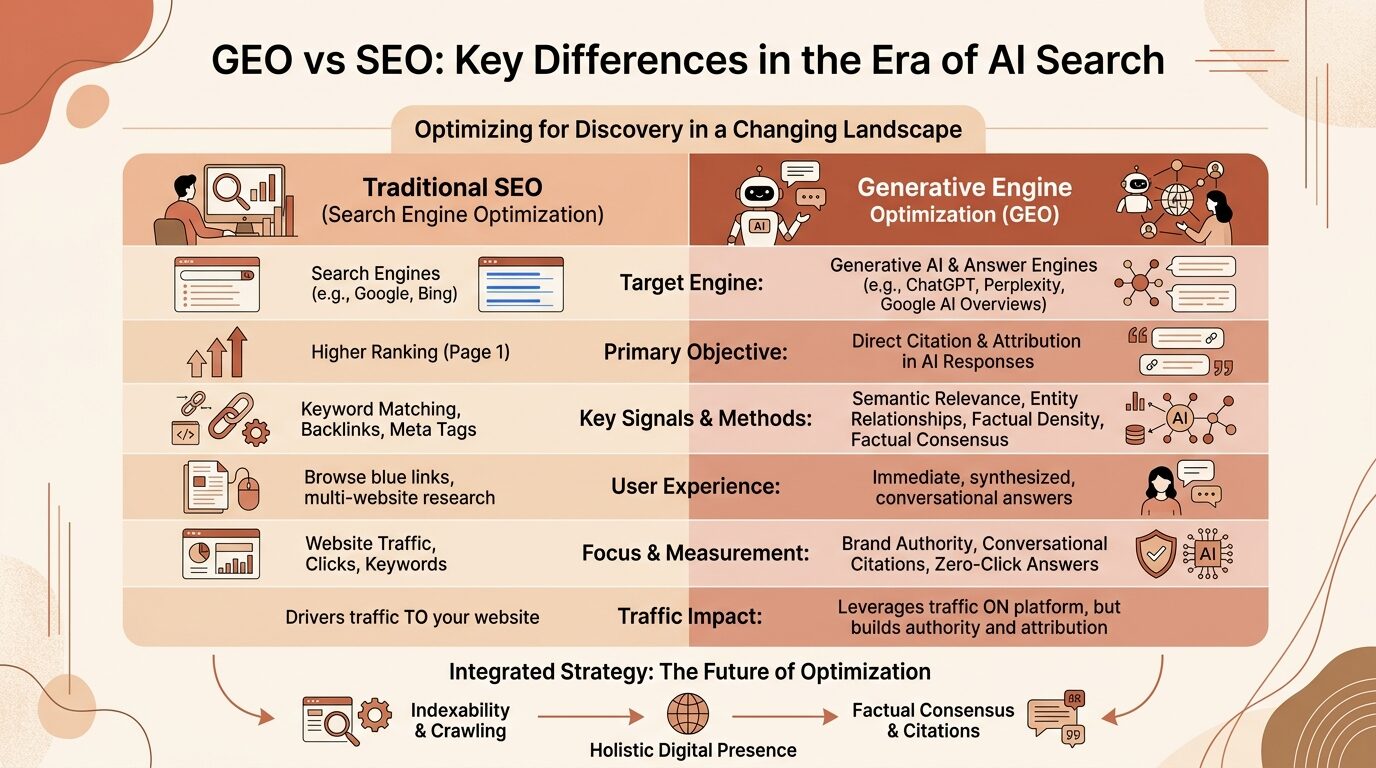
GEO vs SEO Key Differences and How Search Is Changing
GEO vs SEO Key Differences and How Search Is Changing
Search engines have evolved beyond keyword matching and blue link listings. For over two decades, digital marketing relied on traditional Search Engine Optimization (SEO) to secure search engine rankings. However, the rise of artificial intelligence platforms—including ChatGPT, Perplexity, Google AI Overviews, Claude, and Gemini—has fundamentally transformed online discovery, giving birth to Generative Engine Optimization (GEO).
Search behavior is undergoing a massive migration. Modern consumers and commercial buyers no longer enter fragmented keywords to browse multiple websites. Instead, they prompt AI assistants with complex, natural language questions, expecting immediate, synthesized answers.
Bridging traditional SEO with modern GEO is now essential. Organizations must capture traditional organic traffic while ensuring their brand is actively cited inside generative AI answers.
What Is Generative Engine Optimization (GEO)?
Generative Engine Optimization (GEO) optimizes digital content and brand presence so Large Language Models and generative search engines can easily parse, synthesize, and cite your brand as an authority. Rather than indexing pages through keywords and backlinks, AI engines analyze cross-web contextual content to generate conversational answers in real time by evaluating core content signals:
- Direct, factual statements that directly address user questions without conversational filler
- Citation density, authoritative source links, and clear topical attribution
- Structured data markup (Schema.org) that defines real-world entity relationships clearly
- Consensus across multiple reputable web sources, industry publications, and digital directories
- Semantic relevance to long-tail, complex, multi-turn user prompts
- Technical accessibility, ensuring search bots and LLM scrapers can read raw text without JavaScript execution barriers
- Unbiased third-party brand mentions, independent reviews, and peer feedback
The ultimate goal of GEO is not just securing a link on a web page, but earning direct attribution, verbal recommendation, and linked citations inside the generated AI answers presented to potential buyers.
Why GEO Is Becoming Critical
Zero-click searches are rising sharply as AI models answer questions, compare products, and summarize topics directly within search interfaces. This shift drastically reduces traditional website click-through rates. Prioritizing Generative Engine Optimization (GEO) alongside traditional SEO enables content strategists to adapt to changing user behavior, maintain brand visibility, and secure direct citations inside generative AI answers:
- Capturing zero-click answer real estate
- Building conversational brand authority
- Reducing reliance on simple keyword rankings
- Improving cross-platform presence
- Capturing high-intent prospective buyers
Proactive adaptation prevents sudden drops in referral traffic and positions your organization as an early leader in the era of AI-driven answer engine search.
Identifying Hidden Visibility Gaps
Many organizations maintain high organic positions for traditional keywords yet remain completely invisible across popular AI search platforms. Standard SEO auditing tools often fail to diagnose why an AI engine ignores a high-ranking website when generating answers.
Common hidden visibility issues that hinder AI performance include:
- Unclear entity positioning
- Overly complex or marketing-heavy prose
- Lack of verifiable data points.
- Inconsistent cross-channel brand messaging
- Missing or broken Schema markups.
- Reliance on heavy client-side JavaScript
Addressing these hidden visibility gaps ensures your content is not only readable by human audiences but easily indexable and citeable by artificial intelligence algorithms.
Reaching the Modern Searcher
Modern searchers expect AI platforms to aggregate, compare, and synthesize information instantly, eliminating manual research across multiple browser tabs. Failing to optimize content for generative search engines risks total exclusion from buyer decision-making processes. Adapting to AI answer engines prevents severe commercial disadvantages:
- Complete omission from AI-generated buyer shortlists and product comparison tables
- Steady erosion of top-of-funnel organic website traffic and brand awareness
- Loss of direct conversion opportunities to competitors whose content is actively cited by AI assistants
- Decreased ROI on traditional content production efforts that fail to meet new semantic standards
- An over-reliance on increasingly expensive pay-per-click (PPC) advertising campaigns to maintain market presence
Integrating GEO into your broader digital marketing roadmap helps bridge this gap, placing your message squarely in front of users at the exact moment they ask complex questions.
Supporting High-Authority Content Growth
Adopting Generative Engine Optimization does not mean throwing out established content standards. Instead, it demands an elevated commitment to clear, accurate, high-authority publishing. AI models are explicitly trained to identify and reward authoritative, factually backed information while filtering out thin, derivative, or misleading copy.
To build digital content that appeals to both human readers and generative language models, focus on structural and semantic clarity:
- Place clear, 2 to 3-sentence summary answers immediately below main section headings before expanding into detailed explanations.
- Use strict H2 and H3 heading hierarchies, bulleted lists, and formatted data blocks to make content easy for LLMs to scrape.
- Include proprietary survey results, unique case studies, and expert commentary that cannot be copied from other sources.
- Utilize Organization, Article, Product, and FAQ structured data to explicitly define entities and their relationships.
- Frame headers and sub-headers as direct questions that mirror the conversational prompts real people type into AI platforms.
Content that is logically structured, rich in original facts, and easy to parse naturally serves as the ideal training and retrieval material for AI models.
The Importance of Ongoing SEO Foundations
While GEO addresses how AI engines synthesize content, traditional SEO provides the foundational infrastructure that allows web crawlers to discover and index that content in the first place. Generative engines do not operate in a vacuum—they rely heavily on traditional search indexers, high-authority domain backlink profiles, and web crawling protocols to verify source credibility.
Essential SEO practices that directly support your GEO performance include:
- Technical crawlability and indexation
- Strategic internal linking
- Mobile responsiveness and page speed
- E-E-A-T demonstration
- High-quality backlink acquisition
Neglecting traditional SEO fundamentals weakens your overall domain authority, making it vastly harder for generative search engines to trust and reference your content.
Why the AI Search Shift Increases Content Standards
Generative AI search filters out shallow, fluff-heavy articles, favoring sources with clear entity mastery and factual consensus. To earn generative summaries, AI models prioritize content containing original research, structured data, clear semantic relationships, expert insights, and verifiable cross-web facts.
- High factual density with precise figures, clear dates, and verified names
- Direct consensus with other respected digital sources across the same industry
- Clear, unambiguous sentence structures that eliminate room for misinterpretation
- Comprehensive coverage of primary subtopics, addressing potential follow-up questions within the same resource
By raising your content publishing standards, you increase the probability that generative engines will select your site as a trusted reference point when compiling comprehensive summaries.
Brands and B2B Organizations Benefit from GEO
Generative Engine Optimization delivers tangible business value across virtually every industry vertical, particularly for organizations involved in complex, multi-stage sales cycles.
- B2B Software & SaaS
- E-Commerce & Retail
- Professional & Financial Services
- Healthcare & Life Sciences
Proactive implementation of GEO principles allows companies across all sectors to secure early-mover advantages, shaping how their brand, products, and services are portrayed by AI systems.
When Should a Combined GEO and SEO Strategy Be Implemented?
Transitioning from a traditional SEO mindset to an integrated SEO-GEO hybrid strategy should happen immediately, particularly if your organization operates in competitive digital spaces.
Consider accelerating your SEO and GEO integration if you observe any of the following triggers:
- Organic click-through rates from search engines are declining despite stable keyword rankings.
- Your primary target search terms consistently trigger Google AI Overviews or rich answer panels at the top of SERPs.
- Customer feedback indicates buyers are discovering solutions through conversational AI tools like ChatGPT, Gemini, or Perplexity.
- Your sales team notices that prospective clients are arriving with pre-conceived shortlists generated by AI research tools.
- You are planning a major website redesign, content audit, or brand repositioning campaign.
Starting early allows your team to build historical topical authority within generative knowledge bases before competitors optimize their digital footprints.
Why Modern GEO Outperforms Outdated SEO Tactics
Legacy SEO relied on manipulative tactics like keyword stuffing, backlink buying, and thin content to rank on search engine results pages. Modern Generative Engine Optimization (GEO) neutralizes these tricks by shifting focus to Large Language Models and conversational search. Instead of targeting crawler bots through link volume, GEO targets AI engines using semantic context, entity relationships, cross-web factual consensus, and expert citations. The ultimate objective evolves from capturing simple search page clicks to earning direct AI recommendations, verified brand citations, and authoritative answer placements within user conversations.
Conclusion
Generative Engine Optimization is not the death of Search Engine Optimization—it is its natural evolutionary step. While traditional SEO ensures your digital assets are indexed and ranked on conventional search results pages, GEO ensures your brand’s expertise is understood, synthesized, and recommended by the AI models shaping the future of global information retrieval.
By establishing strong technical SEO foundations and pairing them with structured, factually rich, and entity-focused GEO content, businesses can protect their organic reach, expand their brand authority, and thrive in the era of AI-driven search.
FAQS
1. What is a search and GEO assessment?
It is an evaluation of a site’s technical health, structural accessibility, topical authority, and AI indexability. Like a structural inspection, it audits code, entity markup, and content clarity to prevent visibility drops across traditional and AI search.
2. How often should content be inspected for GEO?
Content should be evaluated quarterly. High-competition keywords, fast-moving industries, and core landing pages need continuous monitoring to keep facts, Schema markup, and citation references competitive against frequent AI updates.
3. Can a high-ranking Google page be invisible in AI search?
Yes. Historical backlinks or domain age can drive high traditional rankings, but verbose text, ambiguous statements, missing structured data, or a lack of cross-web factual consensus can cause AI engines to omit it from citations.
4. When should I arrange an SEO and GEO audit?
Schedule an audit if organic traffic plateaus, AI Overviews suppress traditional link clicks, prospective clients find you via AI search, or before executing a site migration or redesign.
5. What happens after an assessment?
Specialists deliver an actionable roadmap covering technical fixes, Schema markup enhancements, content restructuring, and strategic brand placement tactics to maximize traditional SERP rankings and generative AI citations.