
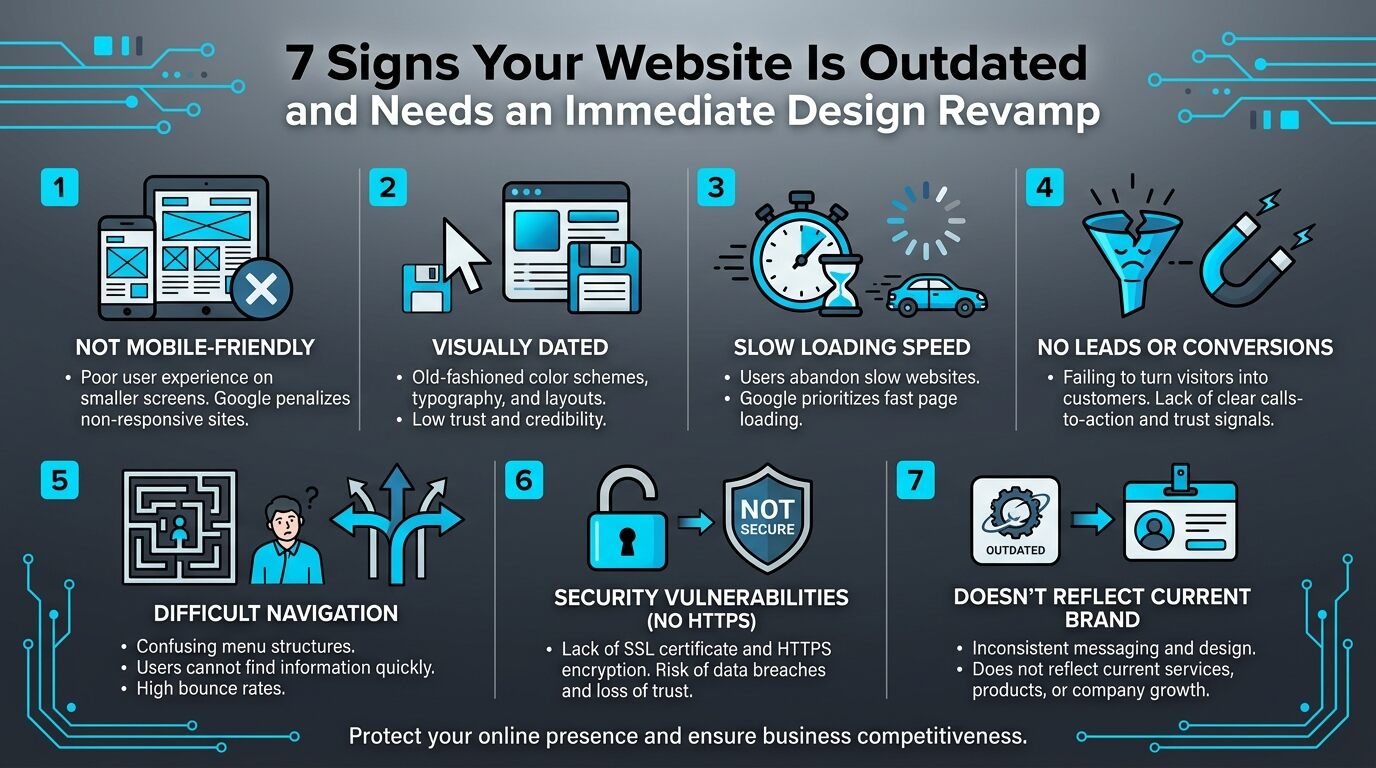
7 Signs Your Website Is Outdated and Needs an Immediate Design Revamp
7 Signs Your Website Is Outdated and Needs an Immediate Design Revamp
Your website is often the first impression potential customers have of your business. A well-designed, modern website builds trust, communicates professionalism, and guides visitors toward taking action. However, when a website becomes outdated, it can silently drive customers away, damage your brand reputation, and hurt your search engine rankings.
Many business owners don’t realize their website is outdated until they notice declining traffic, poor conversions, or customer complaints. Design trends evolve, technology advances, and user expectations change. What worked five years ago may now be costing you valuable leads and sales.
This is why recognizing the signs of an outdated website is essential for protecting your online presence and ensuring your business remains competitive.
A professional website design revamp helps address these issues before they seriously impact your bottom line, allowing you to modernize your site, improve user experience, and stay ahead of competitors.
What Is a Website Design Revamp?
A website design revamp is a comprehensive update to your website’s visual design, functionality, and technical performance. Unlike a complete rebuild, a revamp focuses on modernizing existing elements while preserving what already works.
During a website revamp, professional designers examine various factors, including:
- Visual design and branding consistency
- Mobile responsiveness and cross-device compatibility
- Page loading speed and performance
- User experience and navigation
- SEO structure and technical optimization
- Security features and software updates
- Accessibility compliance
- Conversion elements and calls-to-action
The goal is to determine whether your website meets current industry standards and delivers the experience your visitors expect.
Why Website Design Revamps Are Important
Not every outdated website looks obviously old, and not every design flaw is immediately visible to business owners.
Some critical issues remain hidden until professional analysis and modern tools are used to identify them.
Regular website evaluations help business owners:
- Improve user experience and satisfaction
- Increase conversion rates and sales
- Boost search engine rankings
- Build brand credibility and trust
- Reduce bounce rates
- Stay competitive in their industry
- Future-proof their online presence
Early action often prevents costly consequences like lost customers and damaged reputation.
Identifying Hidden Website Problems
Professional website audits can identify issues that are difficult to detect without proper expertise.
Common hidden problems include:
- Slow loading speeds due to outdated code
- Broken links and missing pages
- Poor mobile responsiveness
- Security vulnerabilities from outdated software
- Inconsistent branding across pages
- Poor accessibility for users with disabilities
- Weak SEO structure and missing meta data
- Outdated plugins and compatibility issues
These issues may significantly weaken your website’s performance even if it appears functional on the surface.
Sign #1: Your Website Isn’t Mobile-Friendly
Mobile devices now account for more than half of all web traffic worldwide.
If your website doesn’t display properly on smartphones and tablets, you’re losing a significant portion of potential customers.
Without proper mobile optimization, outdated websites may cause:
- Text that’s too small to read
- Buttons that are difficult to tap
- Images that don’t resize correctly
- Slow loading on mobile networks
- Horizontal scrolling and layout breaks
- Poor navigation experience
Google also prioritizes mobile-friendly websites in search rankings. A non-responsive site can seriously hurt your visibility.
Sign #2: Your Website Looks Visually Dated
Design trends change rapidly, and what looked modern five years ago may now appear outdated.
Common signs of visual aging include:
- Outdated color schemes and gradients
- Old-fashioned typography and fonts
- Cluttered layouts with too much information
- Low-quality or pixelated images
- Excessive use of stock photos
- Flash animations or auto-playing media
- Inconsistent spacing and alignment
Visitors make split-second judgments about your credibility based on visual design. An outdated appearance can make your business seem less trustworthy.
Sign #3: Your Website Loads Too Slowly
Page loading speed directly impacts user experience, search rankings, and conversion rates.
Studies show that users abandon websites that take more than three seconds to load.
Slow loading may be caused by:
- Outdated hosting infrastructure
- Unoptimized images and media files
- Excessive plugins and scripts
- Poor coding practices
- Lack of caching mechanisms
A professional revamp addresses these performance issues and ensures your site loads quickly on all devices.
Sign #4: Your Website Isn’t Generating Leads or Sales
If your website receives traffic but doesn’t convert visitors into customers, something is wrong.
Common conversion problems include:
- Unclear calls-to-action
- Complicated contact forms
- Lack of trust signals and testimonials
- Poor page structure and flow
- Missing live chat or support options
- No clear value proposition
A design revamp focuses on user experience and conversion optimization, helping turn visitors into paying customers.
Sign #5: Your Website Is Difficult to Navigate
Good navigation is essential for keeping visitors engaged and helping them find what they need quickly.
Signs of poor navigation include:
- Confusing menu structures
- Too many clicks to reach important pages
- Missing search functionality
- Broken internal links
- No breadcrumb navigation
- Inconsistent page layouts
When visitors can’t find information easily, they leave and likely won’t return.
Sign #6: Your Website Isn’t Secure
Security is a critical concern for both you and your visitors.
Outdated websites often lack:
- SSL certificates and HTTPS encryption
- Updated CMS and plugin versions
- Protection against malware and hacking
- Secure payment gateways
- Privacy policy and compliance features
A security breach can damage your reputation, expose customer data, and result in legal consequences.
Sign #7: Your Website Doesn’t Reflect Your Current Brand
Your business evolves over time, and your website should evolve with it.
Signs your website no longer represents your brand include:
- Outdated logo and branding elements
- Messaging that doesn’t match current services
- Missing new products or offerings
- Inconsistent tone and voice
- No reflection of company growth or achievements
A design revamp ensures your website accurately represents who you are today and where you’re heading.
Supporting Healthy Website Growth
A website design revamp isn’t only about fixing problems.
It also helps improve overall performance and future-proof your online presence.
Professional designers may recommend:
- Performance optimization and caching
- SEO improvements and keyword integration
- Content restructuring and updates
- Accessibility enhancements
- Analytics and tracking setup
- Ongoing maintenance plans
A modern, well-maintained website is generally faster, safer, and more effective at achieving business goals.
The Importance of Regular Website Maintenance
Routine maintenance works together with design revamps to ensure long-term success.
Services may include:
- Software and plugin updates
- Security monitoring and backups
- Content updates and additions
- Performance testing and optimization
- Broken link checking and fixes
- User feedback analysis and improvements
Regular maintenance reduces the risk of major issues and extends the lifespan of your website investment.
Why Poor User Experience Increases Business Risks
Frustrated visitors rarely give second chances.
Poor user experience may cause:
- High bounce rates
- Low conversion rates
- Negative reviews and word-of-mouth
- Lost leads and sales
- Damaged brand reputation
- Reduced customer loyalty
A professional website revamp helps eliminate these risks by creating a seamless, enjoyable experience for visitors.
Commercial Websites Benefit from Design Revamps
Businesses across all industries rely on their websites to attract and convert customers.
Industries that especially benefit include:
- E-commerce stores
- Professional service firms
- Healthcare providers
- Hospitality and tourism
- Real estate agencies
- Educational institutions
- SaaS and technology companies
Regular design updates help businesses reduce liability risks while maintaining a competitive edge.
Preventive improvements also minimize unexpected disruptions caused by website failures or security breaches.
When Should a Website Design Revamp Be Performed?
Business owners should consider scheduling a revamp when:
- The website looks visually outdated
- Mobile performance is poor
- Loading speeds are slow
- Conversion rates are declining
- Security vulnerabilities exist
- Branding has evolved
- Competitors have modernized their sites
- Technology is no longer supported
Regular evaluations are especially important for businesses operating in competitive markets.
Long-Term Benefits of Website Design Revamps
Investing in a professional website revamp provides numerous long-term advantages.
Benefits include:
- Improved user experience
- Higher conversion rates
- Better search engine rankings
- Enhanced brand credibility
- Increased mobile traffic
- Stronger security
- Lower maintenance costs
- Greater peace of mind
Preventive improvements are often more cost-effective than responding to problems after damage has occurred.
Conclusion
Professional website design revamps are an essential part of responsible digital marketing and business maintenance. They help identify hidden issues, improve user experience, and reduce the risk of losing customers before problems become obvious.
Whether for e-commerce stores, service businesses, or corporate websites, regular design updates provide valuable improvements that support stronger online presence and healthier business growth. Combined with professional maintenance, SEO optimization, and security updates when necessary, website design revamps help protect both your brand and your bottom line while maximizing the long-term value of your digital investment.
FAQs
1. What is a website design revamp?
A website design revamp is a professional update that improves your website’s visual design, functionality, performance, and user experience. During the process, specialists evaluate your current site, identify weaknesses, and implement modern solutions to enhance appearance, speed, security, and conversion potential.
2. How often should a website be revamped?
The frequency depends on your industry, technology changes, and business goals. Generally, websites should undergo a significant revamp every 3-5 years, with regular updates and maintenance in between. Sites in fast-moving industries may need more frequent updates.
3. Can a functional website still need a revamp?
Yes. A website may work technically while still being outdated in design, user experience, or security. Even if your site loads and functions, it may be driving customers away due to poor mobile performance, slow speeds, or dated appearance. A professional evaluation can identify these hidden issues.
4. When should I arrange a professional website revamp?
You should consider a revamp if your website looks outdated, performs poorly on mobile devices, loads slowly, has declining conversions, shows security vulnerabilities, or no longer reflects your brand. Regular evaluations are also recommended as part of a preventive digital strategy.
5. What happens after a website design revamp?
After completing the revamp, your designer will explain the improvements made and recommend ongoing maintenance. Depending on your needs, this may include performance monitoring, content updates, SEO optimization, security checks, or further enhancements to improve user experience and business results